The Green Girdle’s Symbolism
Sir Gawain and the Green KnightThe Green Girdle is both the safeguard Sir Gawain accepts in fear and the lasting sign by which he remembers that fear. Its symbolism turns on a contradiction: it is offered as protection from harm, but its concealment brings a small wound and exposes a failure of honesty. At the end, Sir Gawain wears it not as proof of invulnerability but as a reminder of human weakness; the fellowship adopts the same green band, transforming his private token of shame into a shared emblem.
The Gift and Its Promise
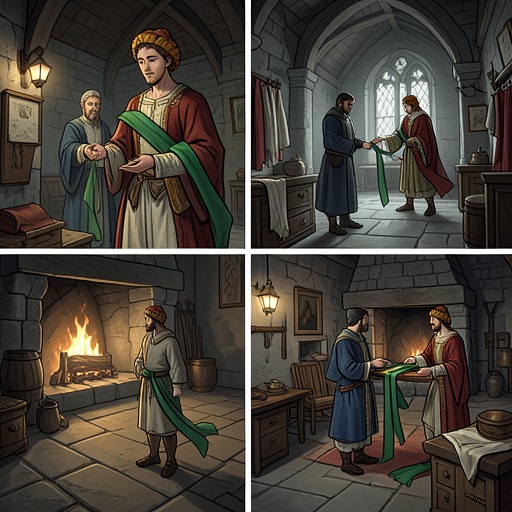
At Bertilak’s Castle, Lady Bertilak first offers Sir Gawain a rich ring of red gold set with a shining stone. He refuses it. She then proposes the green girdle, presenting it as a less costly gift and as an object with a more consequential promise: whoever wears it closely wrapped about him cannot be cut down by any man beneath heaven. Its value therefore lies less in its material worth than in the safety she claims it can provide.
The gift arrives within an existing test of reciprocity. Sir Gawain and Bertilak have agreed to exchange whatever each wins during the day. Sir Gawain accepts the girdle but keeps it secret rather than including it in what he owes his host. That concealment separates the object’s two functions: openly, it is a gift and a charm; within the exchange agreement, it is an undisclosed gain. Its promised protection is bound up from the start with the question of what Sir Gawain is willing to risk, reveal, or withhold.
The girdle’s promise also reverses the ideal embodied by Sir Gawain’s pentangle shield. The shield’s bright red field and gold pentangle are explained through the knight’s reputed fidelity across five virtues and five linked forms of excellence. The girdle, by contrast, becomes significant not because it certifies perfect virtue but because Sir Gawain’s conduct shows the limits of that ideal. One is a public sign of the qualities for which he is renowned; the other records a choice made when fear makes those qualities difficult to sustain.
The Concealment and Its Exposure
The girdle’s protective claim helps explain why Sir Gawain accepts and hides it, but the story makes concealment, not magic alone, decisive. In the exchange of winnings, he does not disclose the object he has received from Lady Bertilak. The bargain’s failure is thus carried in the girdle itself: it is at once the thing he hopes will preserve him and the material trace of what he has withheld from Bertilak.
At the Green Chapel, the Green Knight explains that the girdle was woven by his own wife. He identifies it as the object Sir Gawain wears and connects its concealment to the third blow. The first two strokes do not injure him; the third gives him a nick on the neck. That measured wound makes the girdle’s significance more complex than a simple contrast between magical protection and physical danger. Sir Gawain is not cut down, as the charm promised, but neither does the protection erase the consequence of his concealed choice. The slight wound becomes a bodily counterpart to the fault he must acknowledge.
Once the challenge is explained, the Green Knight releases the girdle’s knot and gives it back to Sir Gawain. The object thereby changes hands again, but its meaning has changed: what had been secretly kept as insurance is returned openly as evidence in a judgment of his conduct. The later revelation that the Green Knight is Bertilak makes the object’s route through the household and the trial explicit. It was woven by Bertilak’s wife, accepted by Sir Gawain, withheld from Bertilak, and finally identified by Bertilak as the sign of the concealed bargain.
A Sign of Fault and Remembrance
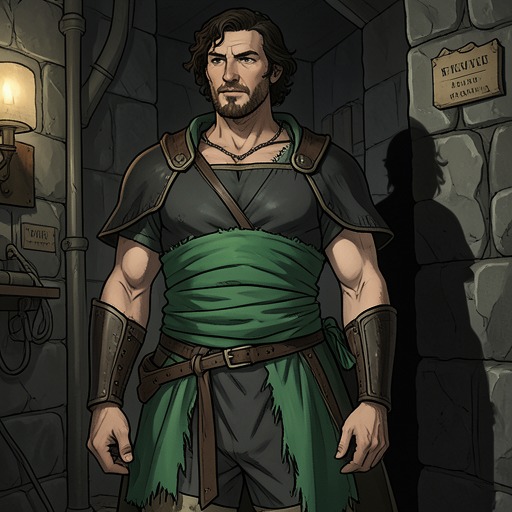
Sir Gawain takes the returned girdle as a sign of his own transgression. He handles it at his neck and describes it as the bond of the blame he bears there. The placement matters: the green band sits where the Green Knight’s stroke has left its nick, making it a visible reminder of a consequence that is slight in the body but lasting in memory. Sir Gawain resolves to see it often when riding in renown, so that the honor attached to his public reputation will recall, rather than conceal, his failure and the frailty of the flesh.
In that use, the girdle no longer promises that its wearer is beyond harm. Sir Gawain preserves it precisely because it recalls that he was afraid and chose to keep the gift back. Its meaning is not that he has become wholly false or that his other virtues count for nothing; rather, the girdle marks the distance between a celebrated ideal and a person who proves vulnerable under pressure. The change from protective charm to reminder of fault makes the object a counter-sign to the polished confidence of the pentangle: it records the limit that an emblem of perfection cannot prevent.
From Private Token to Fellowship Emblem
The final change is social. The lords and ladies associated with the Table agree that every member of the brotherhood will wear a bright green baldric slung about the body, for Sir Gawain’s sake. The repeated form of the original object makes his individual experience visible across the fellowship. What he had worn privately as a reminder of blame becomes a common sign connected to his story.
That adoption does not remove the original meaning. The band continues to recall the concealed girdle and Sir Gawain’s acknowledged weakness, even as the fellowship wears it affectionately. The ending therefore holds shame and honor together rather than simply replacing one with the other: the group’s laughter and shared custom turn the mark into a bond, while Sir Gawain’s own reason for wearing it remains remembrance of his fault. The Green Girdle endures because it can signify both the limits of a knight’s virtue and the fellowship’s willingness to make that limit part of its collective identity.